_1762866128417-DS2_OO1j.png)
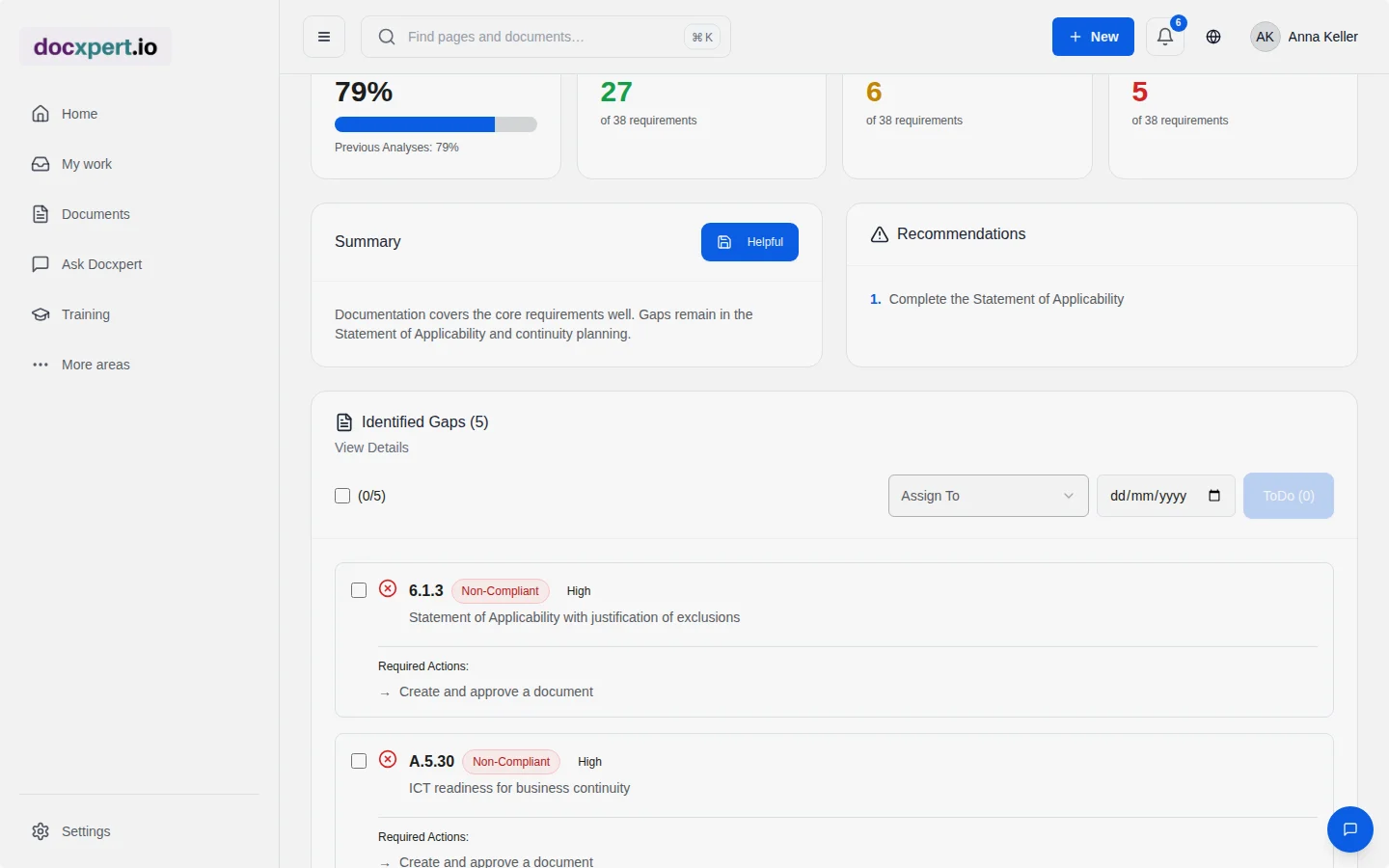
What ISO 9001 is about
ISO 9001 is the most widely used standard for quality management systems. It describes how an organisation plans, controls and improves its processes so that products and services reliably meet customer and regulatory requirements. The standard is industry-neutral – it fits a machine builder just as well as a service provider or a software company.
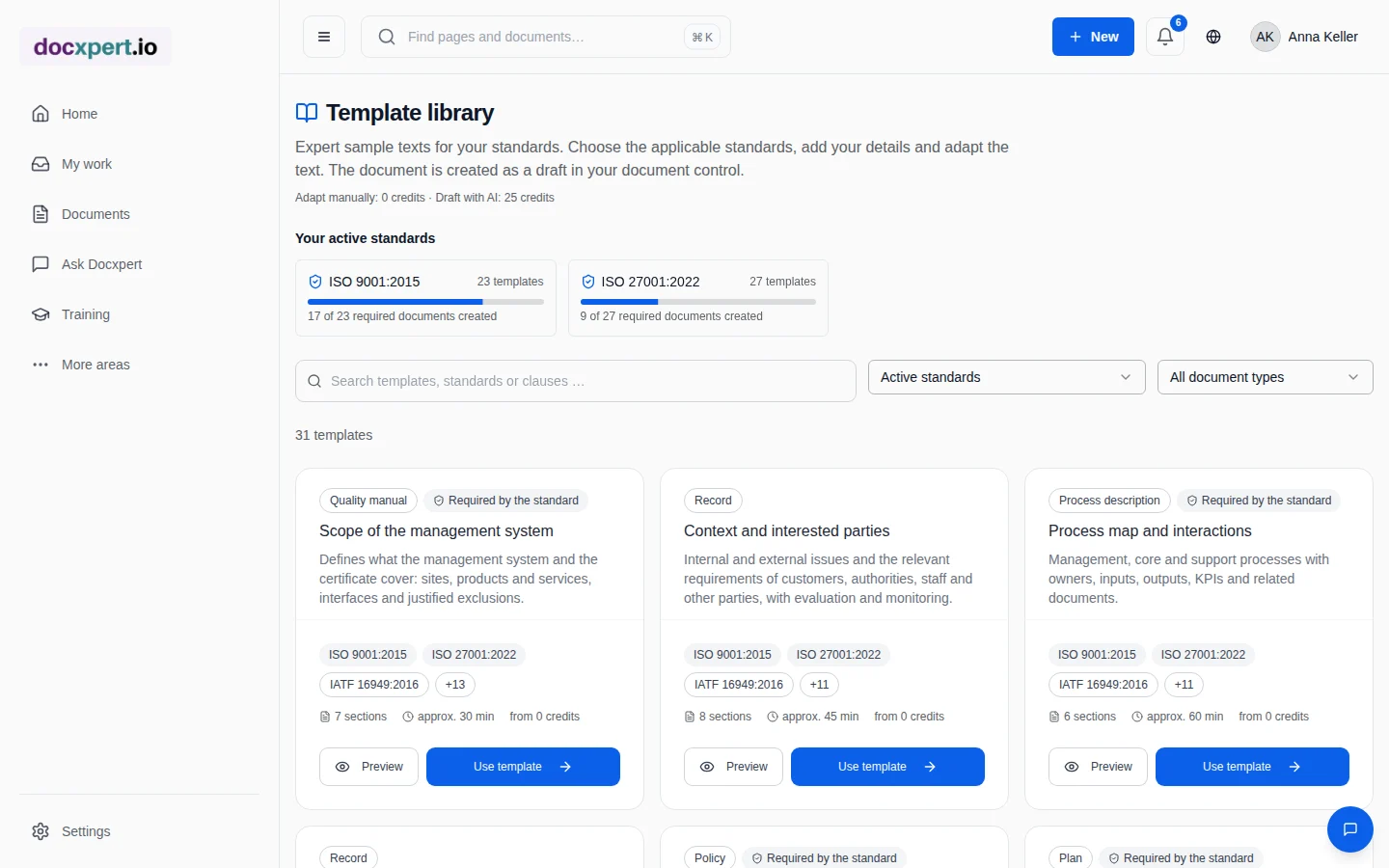
At its core are the process approach, risk-based thinking and the PDCA cycle (Plan-Do-Check-Act). The current edition, ISO 9001:2015, follows the Harmonized Structure shared by all ISO management system standards. That makes it possible to combine quality, environment, occupational health and safety and information security into one integrated management system. A revision of the standard is under way; once a new edition is published, a three-year transition period usually applies.
The requirements at a glance
Clauses 4 to 10 contain the actual requirements. The table shows what each clause asks for and how docxpert supports you.
| Clause | Content | Support in docxpert |
|---|---|---|
| 4 Context | Internal and external issues, interested parties, scope, processes | Templates for context, scope and the process map |
| 5 Leadership | Top management responsibility, quality policy, roles | Templates for the policy and for roles and authorities |
| 6 Planning | Risks and opportunities, quality objectives, planning of changes | Templates for risks, objectives and KPIs; change control |
| 7 Support | Resources, competence, awareness, communication, documented information | Document control, training |
| 8 Operation | Customer requirements, design, suppliers, production, release, nonconformities | Templates for order handling, design and suppliers; deviations |
| 9 Performance evaluation | Monitoring and measurement, customer satisfaction, internal audit, management review | Templates for audit programme, audit report and management review |
| 10 Improvement | Nonconformities, corrective action, continual improvement | CAPA management with effectiveness checks |
Which documents ISO 9001 requires
ISO 9001:2015 talks about "documented information" and distinguishes between information that is maintained (requirements such as the policy or scope) and information that is retained (evidence such as audit results). A quality manual is no longer mandatory – although many companies still use one as an entry point.
- Scope of the QMS (4.3) and quality policy (5.2)
- Quality objectives (6.2)
- Evidence on monitoring and measuring resources (7.1.5) and on competence (7.2)
- Results of the review of customer requirements (8.2.3)
- Evidence on design, supplier evaluation and release (8.3, 8.4, 8.6)
- Records of nonconformities and corrective actions (8.7, 10.2)
- Results of monitoring, internal audit and management review (9.1, 9.2, 9.3)
A detailed list with explanations is in the guide ISO 9001 mandatory documents.
How docxpert supports your ISO 9001 system
Implementing ISO 9001 in six steps
- 1
Clarify context and scope
Which sites, products and processes are included? What do customers, employees and authorities expect?
- 2
Describe processes
A process map shows management, core and support processes and how they interact. Procedures for the most important workflows follow.
- 3
Build the documents
Templates and the AI document generator produce first drafts that subject-matter experts adapt and approve.
- 4
Train employees
New requirements are communicated through trainings and read acknowledgements. The training matrix shows gaps.
- 5
Audit internally and review
An internal audit and a management review are prerequisites for certification. Findings are tracked as CAPAs.
- 6
Get certified
The certification body reviews the documentation in stage 1 and the implementation on site in stage 2. The guide ISO 9001 certification process explains the steps.
ISO 9001 as the basis for an integrated management system
Because all modern ISO management system standards share the same structure, ISO 9001 is often the starting point for further standards. Documents such as the policy, roles, control of documented information, internal audit or management review can be shared. In docxpert, templates contain sections that only appear when the respective standard applies to you.
| Additional standard | Typical additions |
|---|---|
| ISO 14001 | Environmental aspects, legal register, emergency preparedness |
| ISO 45001 | Hazard identification and risk assessment, worker participation |
| ISO 27001 | Risk assessment, statement of applicability, Annex A controls |
| IATF 16949 | APQP, PPAP, FMEA, customer-specific requirements |
Practical tips for a lean QMS
- As few documents as possible, as many as necessary: the standard does not require a specific number. Describe what is really needed for consistent quality.
- Assign clear ownership: every document and process needs an owner who keeps it up to date.
- Meaningful KPIs: a few relevant quality objectives beat an extensive KPI system that nobody uses.
- Use audits as an opportunity: internal audits point to improvements, not just to mistakes.
- Involve employees: comments and suggestions directly on the document keep requirements practical.
Use the certification readiness checklist to check before the audit whether everything is in place.
Frequently asked questions
Do I need special software for ISO 9001?
The standard does not require software. But QMS software makes document control, approvals, training records and corrective actions much easier and provides the audit evidence at the push of a button.
How long does it take to implement ISO 9001?
Small and mid-sized companies usually plan six to twelve months until certification. Templates and a structured gap analysis mainly shorten the documentation phase.
Is a quality manual still mandatory?
No. Since ISO 9001:2015 a manual is no longer required. Many companies still use one as an entry point and overview of their system.
Can docxpert cover several standards at once?
Yes. Templates contain standard-specific sections, and the gap analysis can be run for several of the frameworks stored in docxpert. That lets you build an integrated management system.
Does docxpert replace the certification body or a consultant?
No. docxpert is the tool you use to build and run your system. Certification is carried out by an accredited certification body; you can also work with a consultant if needed.