The blank page is the biggest time sink
Writing a good standard operating procedure typically takes one to several days: read up on the requirements, plan the structure, clarify responsibilities, write. For a complete management system with twenty to thirty documents, that adds up to weeks – or an expensive consulting project.
Generic templates help only so much: they rarely fit your company, have placeholders for everything and are quickly recognised as copies in an audit. docxpert combines a structure that meets the standard with your own input, so the draft describes your processes from the start.
Four ways to a draft
The starter pack: all mandatory documents at once
- 1
Choose standards
One or more standards, for example ISO 9001 and ISO 14001. With several standards you get integrated documents: one policy, one internal audit, one management review for all of them.
- 2
Describe your company
Industry, size, sites, services and special features – typed freely or spoken.
- 3
Upload documents
Existing organisation charts, process descriptions or old manuals feed into the drafts.
- 4
Review the pack
You see which documents will be created and what they cost before anything is generated.
- 5
Edit the drafts
The drafts arrive as documents in draft status in your document control – ready for review and approval.
What makes a good AI draft
- A structure that fits the standard: purpose, scope, terms, responsibilities, procedure, related documents, records.
- Clause references in the text: the relevant clauses of the selected standards are referenced so reviewers can see the coverage.
- Your language: roles, departments and terms from your input instead of generic placeholders.
- Transparent assumptions: where information is missing, AI makes its assumptions visible so you can confirm or change them deliberately.
- Two languages: drafts in English or German – ideal for international teams.
Example: from keywords to a draft ready for review
A manufacturer of precision parts with 80 employees needs a procedure for supplier evaluation under ISO 9001 clause 8.4. In the guided dialogue, the quality manager names the key points: three supplier classes, an annual evaluation of quality, on-time delivery and communication, and blocking after repeated complaints.
From this, AI creates a complete draft with purpose, scope, responsibilities of purchasing and quality assurance, an evaluation scheme, a flow for new suppliers, handling of blocks and the related records. Open points – such as the exact thresholds – are marked as assumptions. After an hour of alignment with purchasing, the document goes into approval.
Which standards?
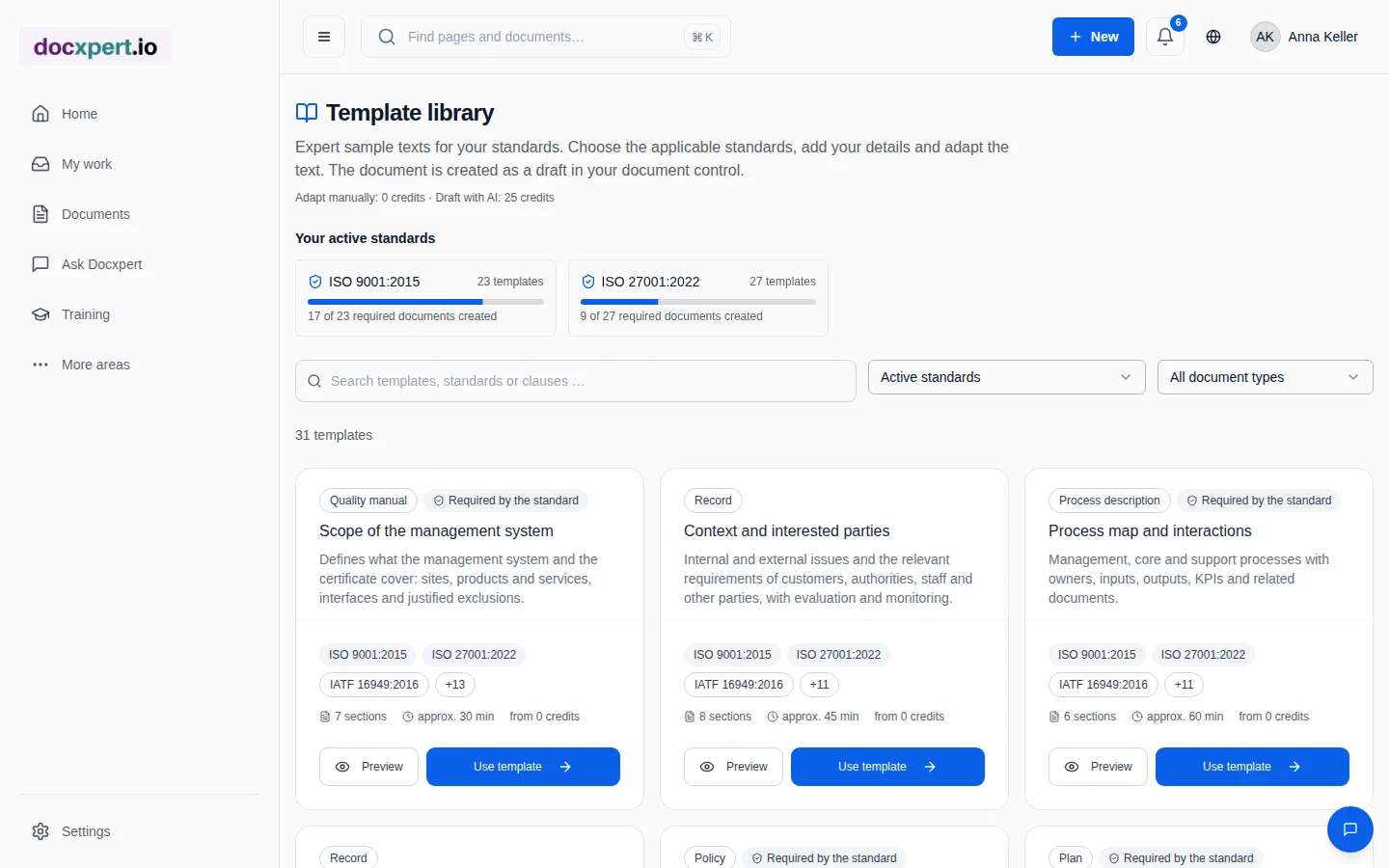
AI drafting uses the same knowledge base as the template library: 65 templates per language for 20 standards and regulations, including ISO 9001, ISO 13485, ISO 14001, ISO 45001, ISO 27001, ISO 42001, IATF 16949, AS9100D, EU MDR, NIS2 and the EU AI Act.
| Document | Typical clause reference | Preparation time with docxpert |
|---|---|---|
| Control of documented information | ISO 9001 7.5, ISO 13485 4.2.4 | Draft in minutes, review about 1 hour |
| Internal audits | ISO 9001 9.2, ISO 27001 9.2 | Draft in minutes, review about 1 hour |
| Corrective action | ISO 9001 10.2, ISO 13485 8.5.2 | Draft in minutes, review about 1 hour |
| Information security policy | ISO 27001 5.2 | Draft in minutes, alignment with management |
Times are experience values for review by a knowledgeable person; the actual effort depends on your processes and alignment.
Tips for better drafts
- Describe your company concretely: products, customers, sites, headcount, specific risks.
- Upload existing documents even if they are out of date – they contain your terms and processes.
- Review responsibilities first. They are the part most often questioned in audits.
- Have process owners read the draft before approval – AI only knows your practice from your input.
- Use the compliance check to see before approval whether all requirements are addressed.
Our guide on how to write an SOP explains how a good procedure is structured.
Data protection and control
AI actions are subject to permissions and are billed in credits; you see the cost before every action. Drafts are created in your workspace and are only visible to authorised people. The privacy policy describes which service providers are used for AI features. AI never changes approved documents on its own.
Frequently asked questions
Can AI write a complete SOP?
Yes, it produces a complete draft with structure, responsibilities and procedure. Reviewing and adapting it remains the job of the responsible people.
Will an auditor recognise AI-written text?
What matters is not who wrote it, but whether the document describes your actual processes and is lived. That is why your input and documents feed into the draft and process owners review it.
In which languages are drafts created?
In English and German.
What does an AI draft cost?
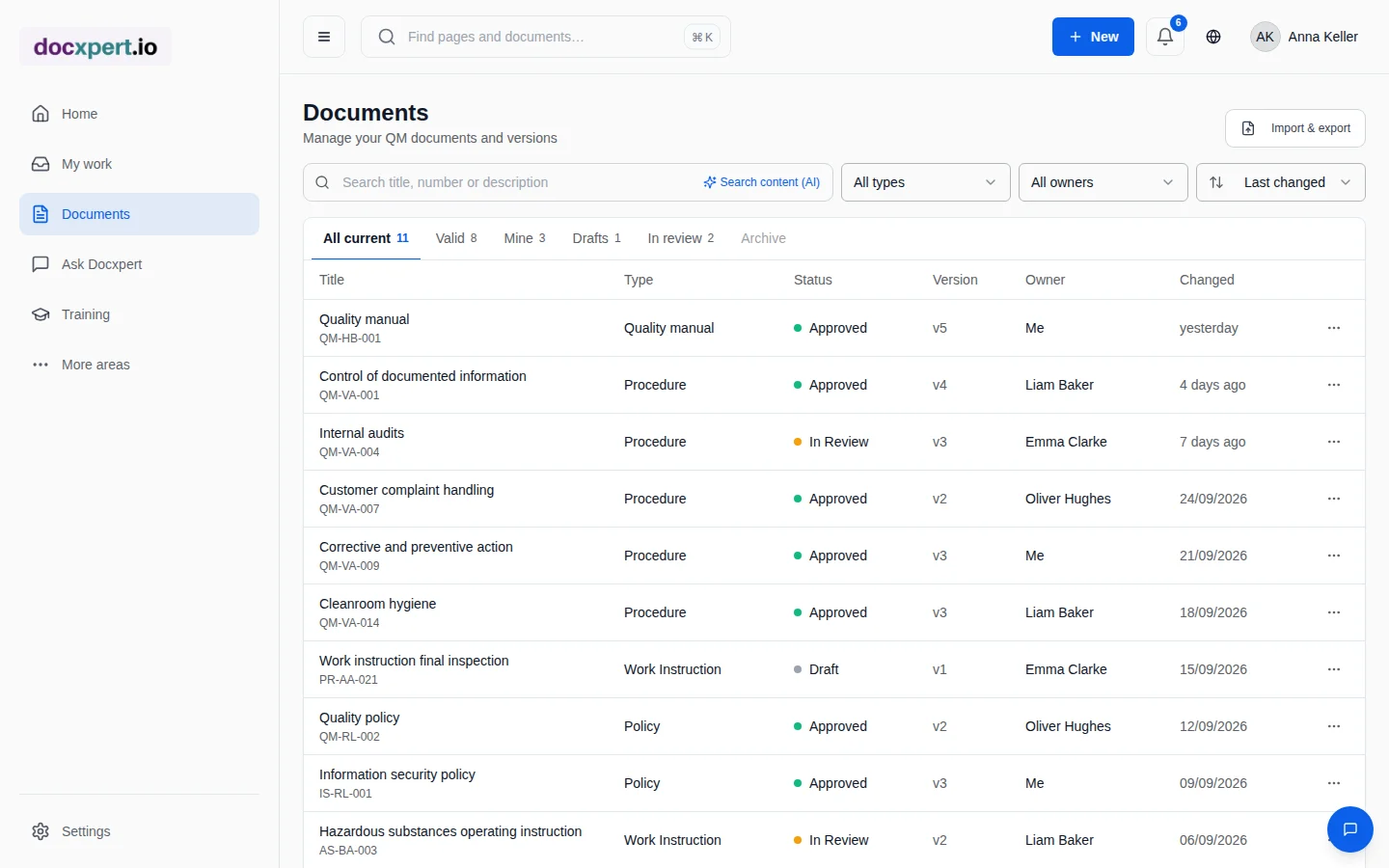
AI drafts use credits. You see the number before you start; manual adaptation of templates is possible without credits.
Are my documents used to train AI models?
Information on service providers and data processing is in the privacy policy. Your drafts stay in your workspace and are only visible to authorised people.
Can one document cover several standards?
Yes. With several standards selected, you get integrated documents that cover the requirements of all of them together.