
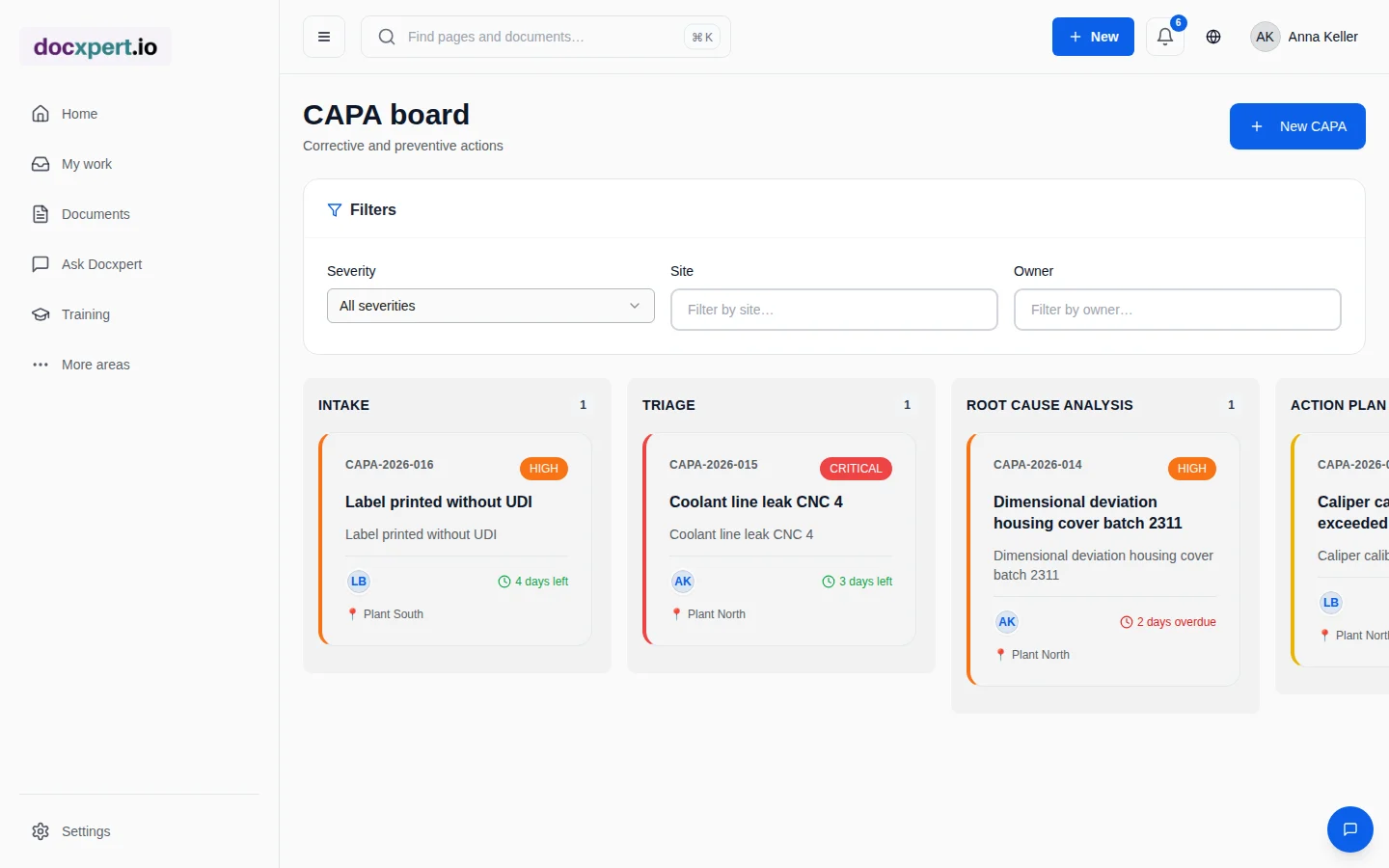
Why CAPAs fail in spreadsheets
Corrective actions are the engine of every management system – and one of the most common sources of audit findings. In spreadsheets and emails, CAPAs quickly lose track: root cause analysis stays superficial, deadlines pass unnoticed and many actions are closed without anyone checking whether the problem has really gone away.
ISO 9001 clause 10.2 requires you to react to nonconformities, determine their causes, implement actions and review their effectiveness. ISO 13485 (8.5.2) and IATF 16949 (10.2.3) go further and require documented procedures and problem-solving methods. CAPA software makes these steps binding, visible and provable.
Nine phases from report to closure
- 1
Intake
Problem, source (complaint, audit, deviation, inspection, risk analysis), category, site and severity are recorded. On request, AI suggests a classification.
- 2
Triage and containment
Containment so that no further damage occurs – with a deadline by severity, 24 hours for critical cases.
- 3
Root cause analysis
5 Whys tree or Ishikawa diagram using the 6M. The analysis is reviewed and approved before actions are planned.
- 4
Action plan
Corrective and preventive actions with owners and dates, each linked to a cause.
- 5
Implementation
Owners record progress and attach evidence.
- 6
Verification
Check that all actions were implemented as planned.
- 7
Effectiveness check
After a defined time, you assess whether the goal was met: green, yellow or red. Red reopens the CAPA.
- 8
Change control
Required changes to documents, training or processes are triggered and tracked.
- 9
Closure
The CAPA is closed with all evidence and remains fully traceable.
Features at a glance
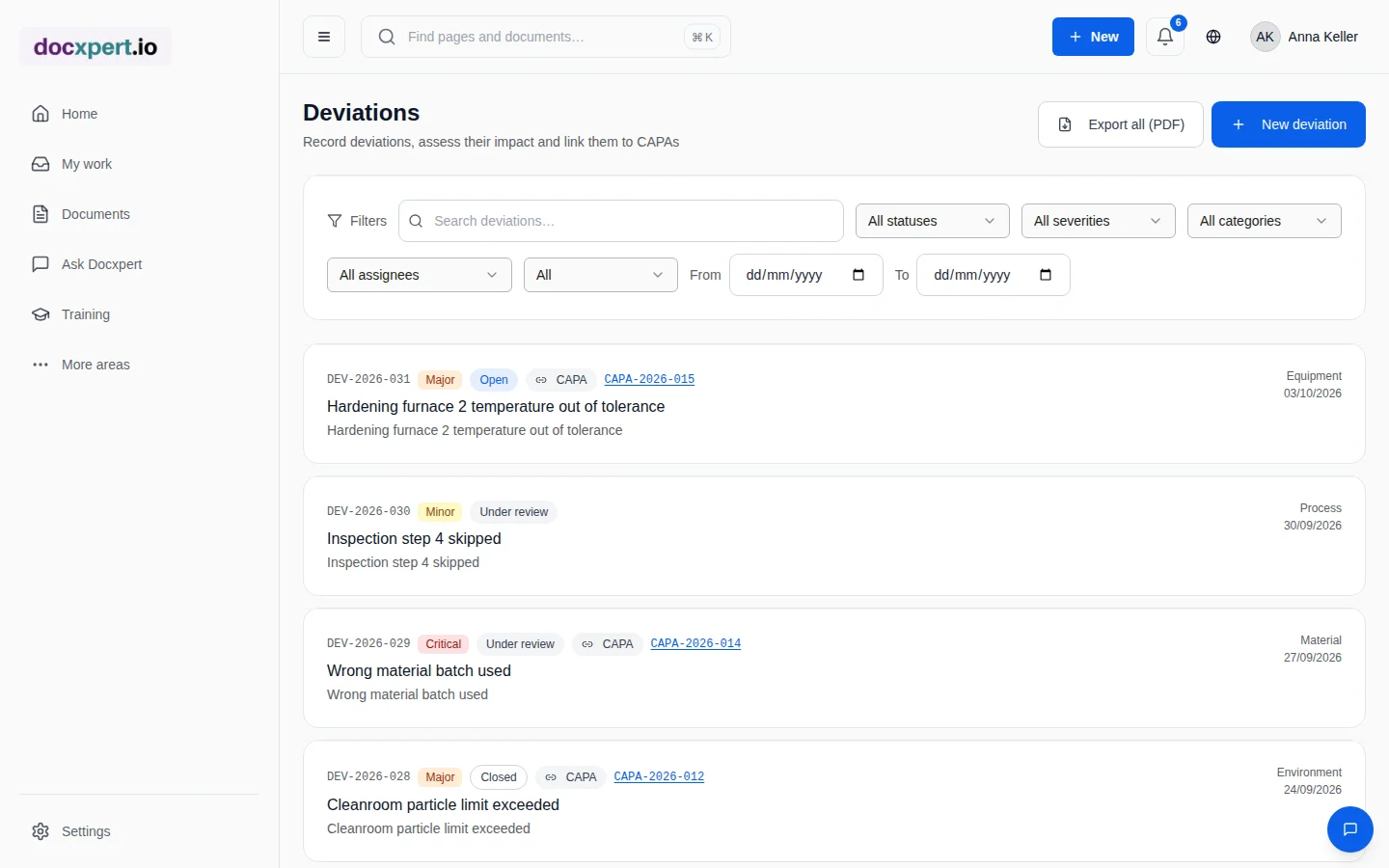
Standards reference
| Standard | Requirement | In docxpert |
|---|---|---|
| ISO 9001:2015, 10.2 | React, determine causes, implement actions, review effectiveness | Triage, root cause analysis, action plan and effectiveness phases |
| ISO 13485:2016, 8.5.2 and 8.5.3 | Documented procedure for corrective and preventive action, verification | Fixed flow with verification and evidence |
| IATF 16949:2016, 10.2.3 | Problem solving with documented methods, including error-proofing | 5 Whys and Ishikawa; extension to similar processes |
| ISO 14001 / 45001, 10.2 | Nonconformity and corrective action, including incidents | Same CAPA logic for environmental and safety topics |
Our guides to the CAPA process, the 8D report and root cause analysis explain the flow in detail. The CAPA checklist helps you close every CAPA properly.
Roles, sources and reporting
CAPAs originate in many places across the company. So that nothing gets lost, docxpert brings all sources into one flow: internal and external audits, customer and internal complaints, nonconformance reports, inspections, risk assessments and improvement ideas. Each CAPA is assigned a category – product, process, system, supplier, regulatory or customer – and has an owner.
| Role | Task in the CAPA |
|---|---|
| Reporter | Records the problem with description, source and an initial assessment |
| CAPA owner | Steers the phases, coordinates the team and keeps deadlines |
| Subject matter team | Carries out the root cause analysis and implements actions |
| Quality management | Approves root cause analysis and deadline extensions, rates effectiveness |
The board shows at any time how many CAPAs are in which phase and which deadlines are at risk. This overview is a valuable input to the management review: where do problems cluster, how quickly are they solved and how often do actions work the first time?
Example: dimensional deviation in series production
During a customer's goods-in inspection, housing covers with a dimensional deviation are found. The quality team records a CAPA with severity “high”: the containment deadline is three days. The affected batches are quarantined and sorted the same day.
The 5 Whys analysis shows that tool wear was not detected in time because the inspection plan only checked every hundredth part. Actions: a changed inspection plan, an additional wear indicator and training for the setters. The inspection plan change runs as a new document version, and the setters receive retraining. After 60 days without another deviation, effectiveness is rated green and the CAPA is closed.
Frequently asked questions
Can I use CAPAs for environmental and safety topics too?
Yes. The flow is independent of the standard and works for nonconformities and incidents under ISO 14001 and ISO 45001 as well as for quality topics.
What does CAPA mean?
CAPA stands for corrective and preventive action – a structured process that eliminates the causes of problems and prevents them from recurring.
Which root cause analysis methods does docxpert support?
The 5 Whys tree and the Ishikawa diagram using the 6M. Both are documented in the CAPA and approved by a second person.
Can I adapt deadlines to our rules?
Deadlines follow severity. For individual cases, deadlines can be extended with a reason; the extension must be approved and is logged.
Does docxpert support 8D reports?
The nine CAPA phases cover the content of an 8D report – from team and problem description through containment and root cause to effectiveness and prevention.
What happens if an action does not work?
With a red effectiveness rating, the CAPA is reopened and goes back into work. The history is preserved.