_1762866128417-DS2_OO1j.png)
What makes laboratories different
Laboratories sell trust in numbers. A test report is only worth as much as the evidence that the method was validated, the equipment calibrated, the person authorised and the result produced impartially. Accreditation bodies therefore assess not just the management system but also sample the chain from order to report.
- Many methods, many versions: standard methods, in-house methods and customer specifications change and must be available at the workstation in their valid version.
- Authorisation, not just training: it is not enough that someone was trained. The lab must define who may perform, evaluate and release which test.
- Impartiality: risks to impartiality must be identified and addressed continuously, including for in-house labs with internal customers.
- Nonconforming work: deviations from procedures or questionable results must be evaluated and handled traceably.
- Assessments: during the accreditation body's assessment, evidence must be quick to find.
Typical documents and records
| Topic | Examples | ISO/IEC 17025 reference |
|---|---|---|
| Impartiality and confidentiality | Management statement, impartiality risk analysis, confidentiality agreements | Clause 4 |
| Personnel | Competence requirements, training and authorisation records, competence monitoring | 6.2 |
| Facilities and equipment | Equipment list, calibration programme, intermediate checks | 6.3 to 6.5 |
| Methods | Test and calibration methods, validation and verification reports, uncertainty budgets | 7.2 |
| Validity of results | Proficiency tests, control charts, repeat measurements | 7.7 |
| Nonconforming work and complaints | Deviation reports, corrective actions, complaint handling | 7.9, 7.10, 8.7 |
| Management system | Control of documents and records, internal audits, management review | 8.3 to 8.9 |
More on the standard itself is on the ISO 17025 laboratory QMS page. The difference between verifying and validating methods is explained in the glossary under verification vs validation.
How docxpert supports laboratories
Introducing docxpert in a laboratory
- 1
Generate the starter pack
Select ISO/IEC 17025 in the starter pack, describe your lab briefly and upload existing documents. docxpert drafts the mandatory documents, which your team reviews and approves.
- 2
Bring in existing methods
Import existing test methods, assign owners and approve them through the approval process.
- 3
Map competence
Create training per method and assign it to the people who perform or release tests.
- 4
Link requirements
Create the clauses of the standard as your own requirements and link each clause to the documents that implement it.
- 5
Prepare for assessment
Run an internal audit and use the links to show evidence per clause quickly.
What assessors often ask
Assessments often follow a sample: a completed job is traced from receipt to report. Prepare the answers to these questions so that you can evidence them within minutes:
- Which version of the method was valid on the test date, and who approved it?
- Was the analyst authorised for the method at that time?
- How was the method validated or verified, and where is the measurement uncertainty?
- How do you monitor the validity of results, for example through proficiency tests?
- Which nonconforming work occurred in the last year, and how was it handled?
- How do you identify new risks to impartiality?
Laboratories within larger organizations
Many laboratories are part of a company certified to ISO 9001 or ISO 13485. In that case it makes sense to define shared processes such as document control, training, complaints and audits only once and to describe the laboratory-specific requirements on top. In docxpert, documents can be mapped to several standards, so one procedure serves both systems.
Make sure the laboratory's impartiality towards internal customers such as production or development is still considered separately. Release testing for your own production in particular is a frequent topic in assessments.
Frequently asked questions
Can docxpert replace a LIMS?
No. docxpert does not manage samples, measurement values or customer test reports. It controls the management system documents and records and so complements a LIMS.
Does docxpert include a ready-made ISO/IEC 17025 requirement catalogue?
No, a licensed catalogue is not included. You can create the clauses as your own requirements and link them to documents. For ISO 17025 there are 19 mapped templates and the starter pack.
How do I map authorisations for individual methods?
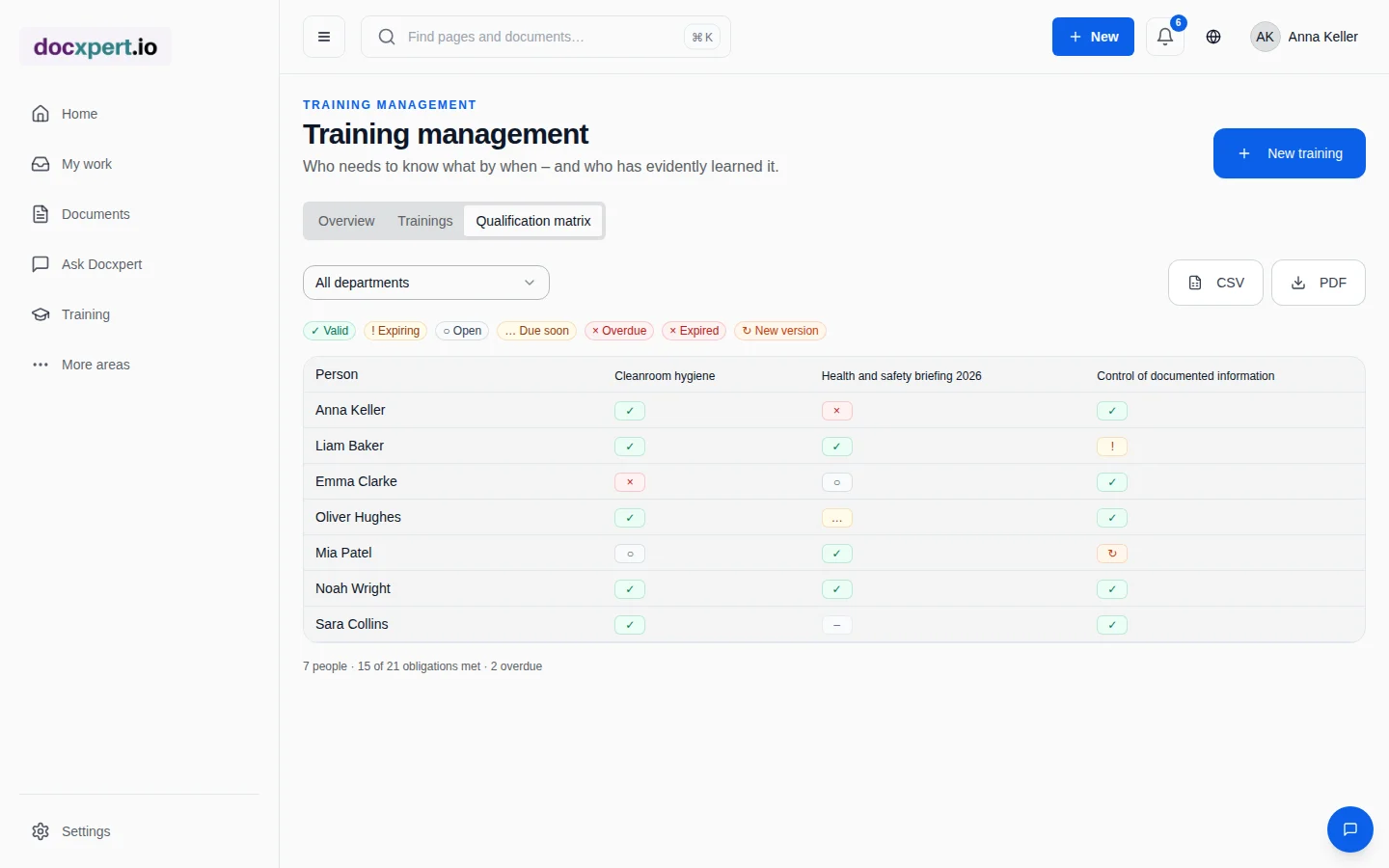
Through training per method and the training matrix. The matrix shows who is trained for which method and when refresher training is due.
Does docxpert help with equipment calibration?
With templates for monitoring and measuring equipment and controlled calibration programmes. docxpert does not manage individual instruments with calibration dates; use a specialist system or a controlled list for that.