_1762866128417-DS2_OO1j.png)
What ISO/IEC 17025 is about
ISO/IEC 17025 sets general requirements for the competence, impartiality and consistent operation of testing and calibration laboratories. It is the basis for accreditation – by UKAS in the UK, A2LA or ANAB in the US, DAkkS in Germany and the national accreditation bodies of other countries.
Unlike ISO 9001, ISO 17025 is not purely a management system standard. The focus is on technical competence: a laboratory must show that its results are valid. This includes qualified staff, suitable and calibrated equipment, validated methods, known measurement uncertainties and measures to ensure the validity of results.
Structure of the standard
| Clause | Content | Typical evidence |
|---|---|---|
| 4 General requirements | Impartiality and confidentiality | Impartiality risk assessment, confidentiality rules |
| 5 Structural requirements | Legal responsibility, management, scope of activities | Organisation chart, responsibilities |
| 6 Resources | Personnel, facilities, environmental conditions, equipment, metrological traceability, externally provided products | Competence records, calibration certificates, supplier evaluation |
| 7 Process | Requests and contracts, methods, sampling, handling, technical records, measurement uncertainty, validity of results, reports, complaints, nonconforming work | Validation reports, proficiency tests, test reports |
| 8 Management system | Option A (own requirements) or option B (per ISO 9001) | Document control, audits, management review |
Personnel: competence, authorisation, monitoring
Clause 6.2 requires the laboratory to define competence requirements for each function, and to select, train, supervise, authorise and monitor the competence of its personnel. People are authorised for specific activities – such as performing a particular test method, evaluating results or authorising reports.
- Competence requirements per function: education, qualification, training, technical knowledge and experience.
- Induction and training with records, including method and equipment authorisations.
- Authorisation for specific laboratory activities, documented with date and authorising person.
- Monitoring of competence, for example through repeat measurements, proficiency tests or observation.
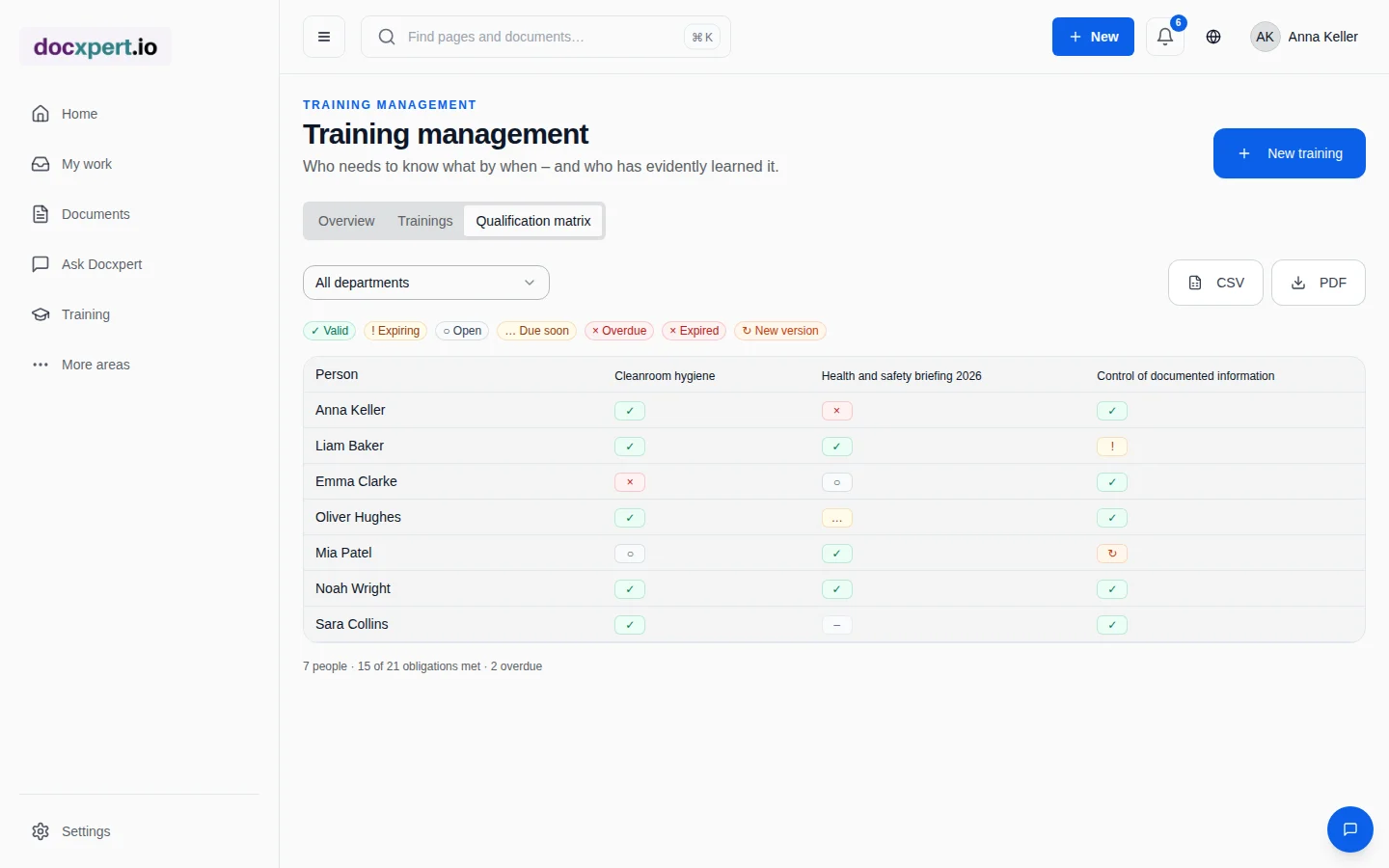
In docxpert, the training matrix shows who is trained for which methods and when a refresher is due.
How docxpert supports your laboratory
Ensuring the validity of results
Clause 7.7 requires a procedure for monitoring the validity of results. Data is recorded so that trends can be detected and, where practicable, analysed statistically. Typical measures include:
- Use of reference materials and quality control samples
- Replicate tests using the same or different methods
- Participation in interlaboratory comparisons and proficiency tests
- Comparisons between analysts and instruments
- Review of reports by a second authorised person
Unusual results lead to an evaluation as nonconforming work and, where needed, to corrective actions. In docxpert you link the finding to the affected test instruction and track the action through to the effectiveness check.
Option A or option B?
Clause 8 allows two routes. Under option A, the laboratory meets the management system requirements of 8.2 to 8.9 directly. Under option B, it operates a management system according to ISO 9001 that supports the requirements of clauses 4 to 7. Option B makes sense when the laboratory is part of a company with an existing ISO 9001 system.
| Requirement | Clause (option A) |
|---|---|
| Management system documentation | 8.2 |
| Control of management system documents | 8.3 |
| Control of records | 8.4 |
| Actions to address risks and opportunities | 8.5 |
| Improvement | 8.6 |
| Corrective actions | 8.7 |
| Internal audits | 8.8 |
| Management reviews | 8.9 |
The path to accreditation
- 1
Define the scope of accreditation
Which test or calibration methods should be accredited? The scope determines the effort for validation and competence evidence.
- 2
Build the management system
Choose the option, set up document control and document procedures for complaints, nonconforming work and corrective actions.
- 3
Validate methods
Verify or validate methods, determine measurement uncertainty and ensure traceability of measuring equipment.
- 4
Qualify and authorise staff
Define competence requirements, train, authorise and monitor competence.
- 5
Ensure validity of results
Plan and evaluate proficiency tests, control samples and repeat measurements.
- 6
Audit internally and apply
Carry out the internal audit and management review, then submit the application to the accreditation body.
Practical tips
- Assess impartiality actively: risks to impartiality – such as financial dependence on customers – must be identified on an ongoing basis, not just once.
- Keep technical records complete: raw data, calculations and the person performing the work must be traceable.
- Plan proficiency testing: an overview of planned proficiency tests per method makes the assessment easier.
- Agree decision rules: for statements of conformity, the decision rule must be agreed with the customer.
Frequently asked questions
What is the difference between ISO 17025 and ISO 9001?
ISO 9001 assesses an organisation's quality management system. ISO 17025 additionally confirms a laboratory's technical competence for specific methods. Accredited test results require ISO 17025.
Which edition of ISO 17025 applies?
ISO/IEC 17025:2017 currently applies. A revision is under discussion; until a new edition is published, the 2017 edition remains authoritative.
Can docxpert manage lab equipment and calibrations?
docxpert includes a template for monitoring and measuring equipment that you use to document your calibration and traceability procedure. docxpert does not currently offer dedicated equipment management with calibration schedules; many labs use a LIMS for that.
Does docxpert replace a LIMS?
No. A LIMS manages samples, measurement data and test reports. docxpert is the management system for documents, competence, deviations, audits and improvements. The two complement each other.
How do I demonstrate staff competence?
Through documented competence requirements, training records, dated authorisations and regular monitoring. In docxpert, trainings, certificates and the training matrix are in one place.
Is there an automatic gap analysis for ISO 17025?
There is currently no dedicated requirement catalogue for ISO 17025 in the gap analysis. The 19 templates do show the related clauses for each section.
How should a laboratory demonstrate competence and authorisation for testing?
Define the education, practical experience and observable capability required for each method. Distinguish general training from authorisation to perform particular tests independently, evaluate results or release reports. Keep meaningful evidence: observed work, blind or comparison samples, competence discussions and an assessment by an appropriate person. An attendance certificate alone does not show that a method is applied correctly. Set review triggers, such as a long interruption, method change or unusual results. Criteria should fit the complexity and risk of the task. Also record who authorised each activity and any limits on that authority. This lets laboratory management and assessors trace how results were produced and reviewed by competent, authorised personnel.