_1762866128417-DS2_OO1j.png)
Typical challenges in machinery manufacturing
- Many variants, small batches: engineer-to-order means many documents that change often. Anyone working in assembly with an outdated drawing or instruction produces costly rework.
- Knowledge in people's heads: experienced fitters and commissioning engineers know what matters. That knowledge leaves with retirement unless it is captured.
- Complaints at the customer site: errors often only show during commissioning at the customer. The causes then lie in design, purchasing or assembly and must be clarified across departments.
- Several management systems: large customers often require environmental and occupational safety evidence alongside ISO 9001. Separate manuals mean double maintenance.
- Suppliers: bought-in parts and contract manufacturing make up a large share of value added. Their quality and delivery reliability decide your deadlines.
Documents typically needed
| Area | Examples | Standard |
|---|---|---|
| Order handling | Enquiry and contract review, order clarification, delivery release | ISO 9001 8.2, 8.6 |
| Design and engineering | Design planning, design reviews, approval of design changes | ISO 9001 8.3 |
| Manufacturing and assembly | Work and inspection instructions, inspection plans, identification | ISO 9001 8.5 |
| Measuring equipment | Equipment list, calibration programme | ISO 9001 7.1.5 |
| Suppliers | Supplier selection and evaluation, incoming inspection | ISO 9001 8.4 |
| Errors and improvement | Deviation reports, 8D reports, corrective actions | ISO 9001 8.7, 10.2 |
| Environment and safety | Environmental aspects, risk assessments, legal register, emergency preparedness | ISO 14001, ISO 45001 |
Which documents ISO 9001 actually requires is explained in the guide ISO 9001 mandatory documents. For measuring equipment, see calibration of measuring equipment in the glossary.
How docxpert supports machinery manufacturers
A practical example
A special-purpose machinery builder with 180 employees receives a complaint: during commissioning at the customer, a wrongly connected pneumatic line is found. Assembly had worked to an instruction that was not updated after a design change. The printout at the assembly station was three revisions old.
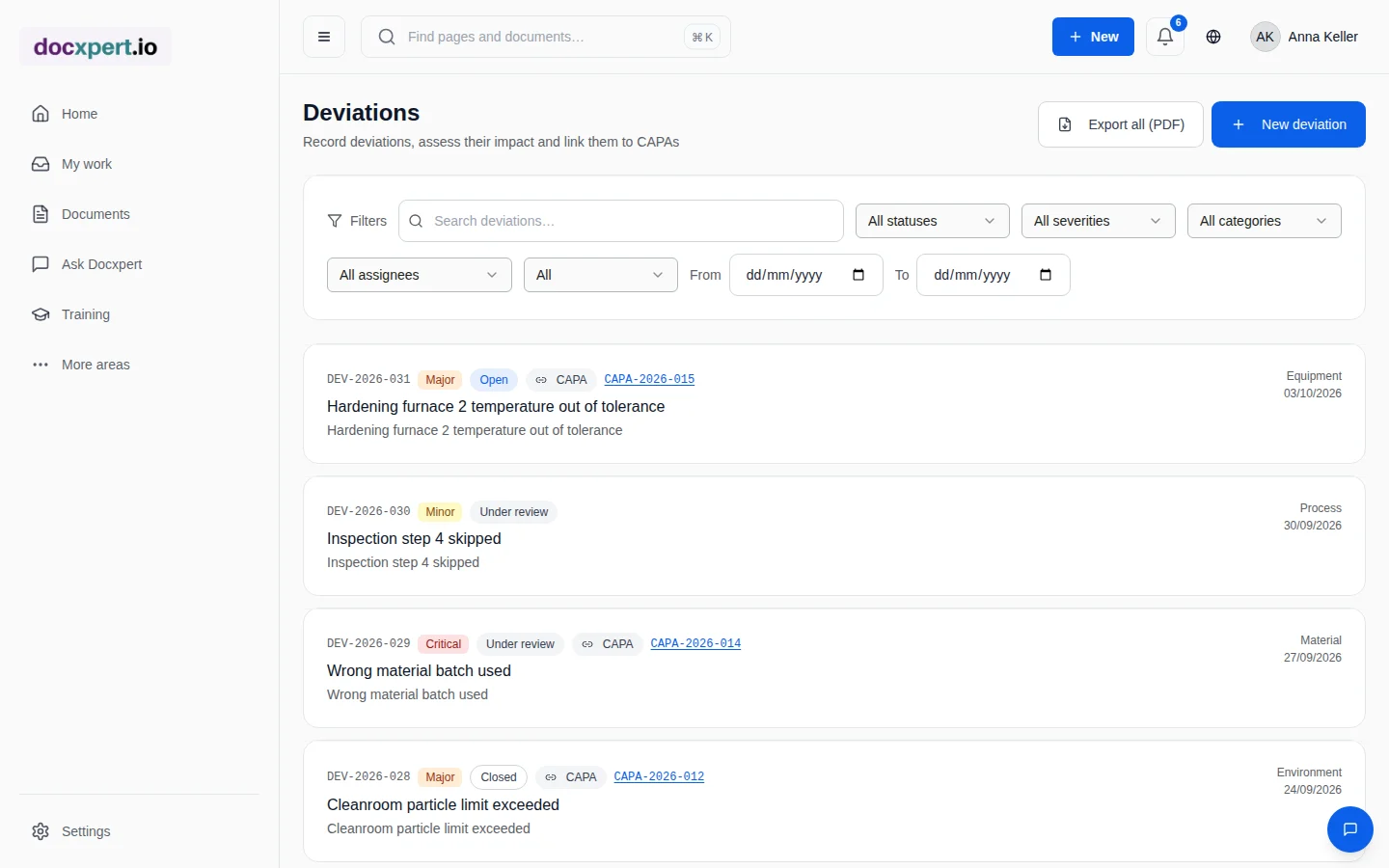
The deviation is recorded and the cause clarified with an 8D report: design changes did not trigger a review of the affected assembly instructions. The corrective action now links every design change to the related instructions, and only controlled copies with a verification code hang at assembly stations. After three months, the effectiveness check shows no comparable errors. Auditors like exactly this kind of evidence because it closes the chain from error to cause to effectiveness.
Running ISO 9001, 14001 and 45001 together
Management system standards share the same basic structure. Context, leadership, planning, support, operation, evaluation and improvement can therefore be handled together. Many machinery manufacturers start with ISO 9001 and add environmental and safety topics step by step, often prompted by customer requirements.
In docxpert you select several standards at once in the starter pack. The pack then creates integrated documents instead of three parallel manuals. You can also use the ISO 14001 requirement catalogue for the gap analysis; for ISO 45001, templates and the starter pack are available. The differences between quality and environmental management are explained in ISO 9001 vs ISO 14001.
Suppliers and bought-in parts
In machinery manufacturing, the supply chain decides quality and deadlines. ISO 9001 requires you to select, evaluate and monitor external providers against defined criteria and to communicate your requirements clearly. The 2026 edition adds that these requirements may also cover the providers' interactions with your customers, for example subcontracted fitters on site.
In docxpert you use the templates for suppliers and external providers and for supplier evaluation. Complaints against suppliers are recorded as deviations and linked to the corrective action. See supplier evaluation in the glossary.
Step-by-step introduction
- 1
Bring in what you have
Import existing documents from network drives or SharePoint and assign owners.
- 2
Identify gaps
Use the gap analysis to check which requirements your documents cover and where evidence is missing.
- 3
Connect the shop floor
Approve the most important work and inspection instructions and bring them to the workstations as controlled copies.
- 4
Build an error culture
Record deviations consistently, analyse causes and carry insights into instructions and training.
- 5
Prepare for ISO 9001:2026
The free transition check shows which changes of the new edition affect your system.
Frequently asked questions
Does docxpert replace our CAQ system?
No. Measurement data, statistical evaluations and equipment management stay in the CAQ or specialist system. docxpert controls the management system documents and records.
Can we run ISO 9001 and ISO 14001 in one system?
Yes. Documents can be mapped to several standards, and the starter pack creates integrated documents for the standards selected.
How do we get valid instructions onto the shop floor?
With controlled copies. Each printout carries a verification code to check validity; withdrawn versions are shown as invalid.
Does docxpert support 8D reports?
Yes, with a template for deviation and 8D reports and deviation and CAPA management for causes, actions and effectiveness checks.