The knowledge is there – it is just hard to find
A mature management system quickly grows to hundreds of documents: procedures, work instructions, policies, forms. The answer to a specific question often sits in section 6.2 of a document whose title nobody remembers. So people ask – the quality manager, or the colleague who has been around longest.
That costs time and carries a risk: verbal answers are not always current. A knowledge assistant that reads the valid documents directly and names the source turns the management system into a reference people actually use.
How the knowledge assistant works
- 1
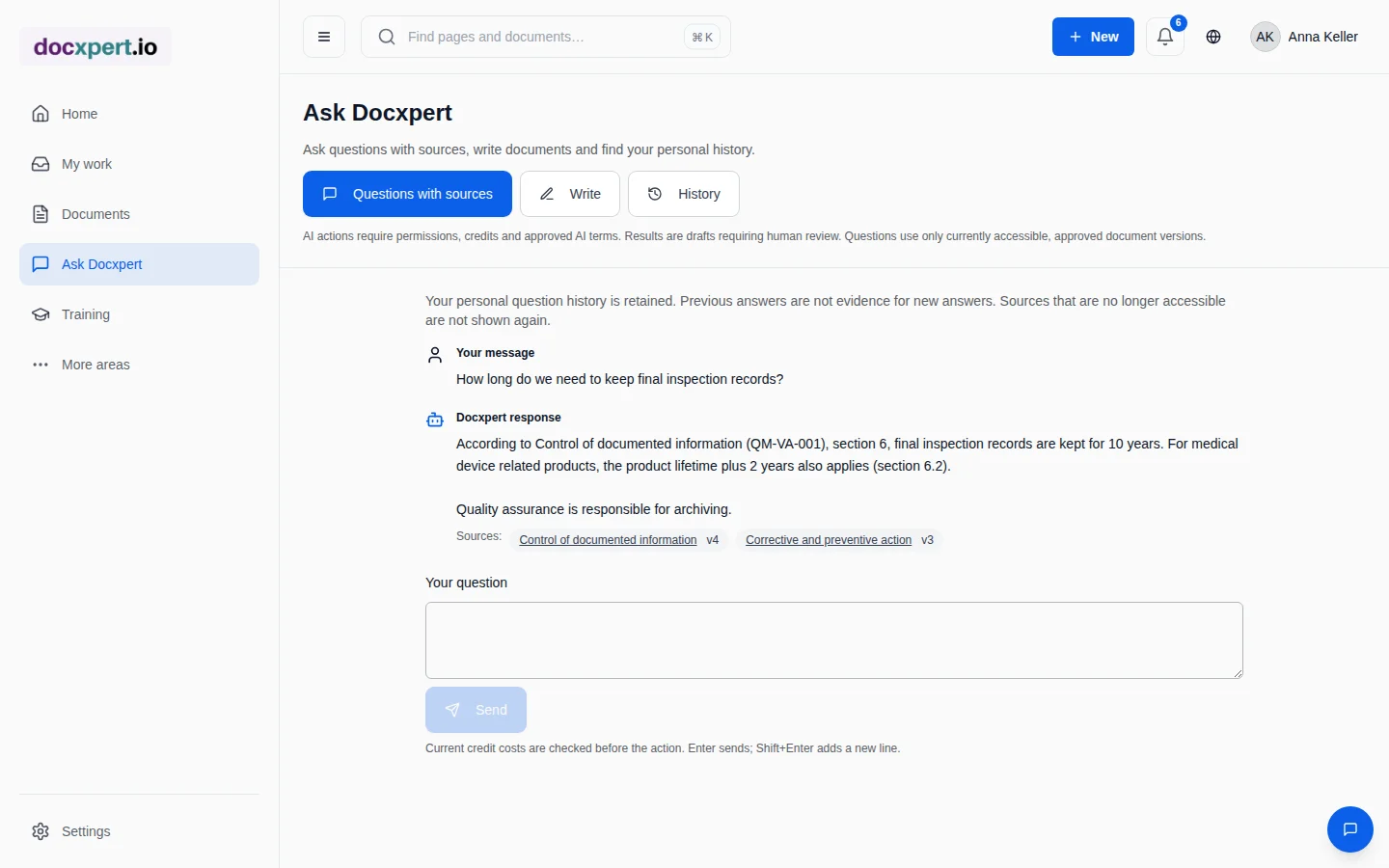
Ask a question
In natural language, in English or German – the way you would ask a colleague.
- 2
Find relevant passages
Semantic search finds matching sections even when different terms are used. Only documents you have access to, and only their currently approved versions, are considered.
- 3
Answer with sources
AI writes an answer based on the passages found and lists the source documents with version. One click opens the document.
- 4
Follow up
In the conversation you can follow up or add context. Your personal question history is kept.
Features at a glance
Typical questions in practice
| Area | Example question |
|---|---|
| Production | What do I do if the gauge on the line is not calibrated? |
| Purchasing | At what rating is a supplier blocked? |
| HR | Which training does a new employee in final inspection need? |
| IT security | How do I report a suspected phishing attack? |
| Health and safety | Where are the first-aid rules for handling hazardous substances? |
| Audit preparation | Where is it defined how we handle obsolete documents? |
Example: onboarding in final inspection
A new employee in final inspection has plenty of questions in the first week: what to do with a borderline sample? Who decides on concessions? Where is a blocked part labelled? Instead of looking for the shift lead every time, he asks docxpert. The answers point to the inspection instruction, the procedure for nonconforming products and the concession form – each in its current version.
The shift lead saves time, the employee gets to know the documents he works with, and the quality manager sees from recurring questions where rules are unclear. In addition, training management makes sure the most important documents are also trained with evidence.
Security and data protection
The knowledge assistant works within your workspace and respects the access rights of every document. Documents are indexed for semantic search; only authorised people get answers from them. AI actions are subject to permissions, billed in credits and labelled as AI output. The privacy policy describes which service providers are used for AI features.
Companies that have to govern their own AI systems under the EU AI Act or ISO 42001 can record the assistant in the AI register – including purpose, role and risk tier.
What changes day to day
- Fewer questions to the quality team, because employees can look things up themselves.
- Documents get used more, because the answer leads straight to the right section.
- Faster onboarding for new employees who find their way without prior knowledge of the system.
- Better audits, because employees know the rules and can show where they are written.
- Gaps become visible: if the assistant finds no answer, a rule may be missing – a pointer for the gap analysis.
Tips for good answers
- Ask specifically: “How long do we keep final inspection records?” rather than “Retention?”.
- For important decisions, always check the cited passage in the document.
- Keep document titles and section headings clear – search and answers benefit from it.
- If an answer is wrong or outdated, the document is often unclear: a good reason for a new version.
Frequently asked questions
How quickly are new documents available in the assistant?
New and changed documents are indexed after approval and are then available for questions. Archived versions are excluded from answers.
Where does the assistant get its answers?
Only from documents in your workspace that you have access to, and only from their currently approved versions. The sources are listed below every answer.
Can the assistant reveal confidential documents of other departments?
No. It only uses documents the person asking may open themselves.
What happens if no matching passage is found?
The assistant says so instead of inventing an answer. That often points to a missing rule.
Is the answer binding?
The cited, approved document is binding. The answer is a summary that shows you the way there.
Which languages does the assistant support?
English and German. Questions and documents can be in different languages.
What does it cost?
Questions use credits from your allowance. The free trial includes up to 50 questions.
How should quality teams review answers and handle knowledge gaps?
Treat an AI answer as a pointer, not as a new instruction. Open the cited, approved version and check that the passage, scope and conditions really fit the question. For safety- or quality-critical decisions, the responsible role should read the full context rather than reuse one sentence. If no reliable source appears, record the open question and determine whether a rule is missing, difficult to find or worded ambiguously. Do not turn an informal chat answer into a process rule. A reviewed document change keeps the resolution traceable and available to everyone. Repeated search questions can also show the quality team which content needs clearer titles, better structure or additional training.