_1762866128417-DS2_OO1j.png)
What the standards require
ISO 9001 clause 7.2 c requires the organisation, where applicable, to take actions to acquire the necessary competence and to evaluate the effectiveness of the actions taken. ISO 13485 clause 6.2 goes further and requires a documented procedure and evidence of effectiveness proportionate to the risk of the work. ISO 45001, ISO 27001 and IATF 16949 also expect training not just to take place but to achieve its objective.
The standards do not prescribe a specific method. They leave you room as long as the evaluation is traceable, documented and proportionate to the risk. A short safety briefing needs a different evaluation than qualifying someone for a critical inspection process.
No learning objective, no effectiveness
Effectiveness can only be evaluated if it is clear beforehand what the training should achieve. Define a concrete, verifiable objective for each training:
| Vague | Verifiable |
|---|---|
| Employees know the new work instruction. | Operators set up machine X according to WI-12 without questions; no set-up errors in the next 30 days. |
| Information security awareness. | Click rate in the next phishing simulation falls below 5%. |
| Complaint handling training. | 8D reports contain complete root cause analyses; processing time under 10 working days. |
Kirkpatrick's four-level model
The best-known model for evaluating training comes from Donald Kirkpatrick. It distinguishes four levels that build on each other:
| Level | Question | Typical method | Effort |
|---|---|---|---|
| 1 Reaction | How satisfied were participants? | Feedback form | Low |
| 2 Learning | What did they learn? | Quiz, test, practical exam | Low to medium |
| 3 Behaviour | Do they apply it at work? | Observation, conversation with the manager, sampling | Medium |
| 4 Results | Has something measurably improved? | KPIs such as error rate, complaints, accidents | High |
Level 1 alone is not enough to demonstrate effectiveness – satisfaction says little about competence. For most trainings a combination of levels 2 and 3 is appropriate. Level 4 pays off for trainings with major impact.
Methods at a glance
- Knowledge test or quiz: right after the training, with a defined pass mark. Simple and easy to document.
- Practical assessment: the person performs the task under supervision; the observation is recorded.
- Manager evaluation: a few weeks after the training, the manager evaluates whether the content is applied.
- Sampling: work results are checked for compliance with the trained requirement, such as inspection records or reports.
- KPIs: compare error rates, complaints, accidents or audit findings before and after the training.
- Self-assessment with follow-up: participants rate their confidence; anomalies are clarified in conversation.
Scaling effort to risk
Not every training needs the same depth of evaluation. A risk-based approach keeps the effort reasonable and is easy for auditors to follow:
| Risk of the task | Examples | Appropriate evaluation |
|---|---|---|
| Low | General information, quality policy | Read acknowledgement or short quiz |
| Medium | Work instructions, software training | Quiz plus manager evaluation after a few weeks |
| High | Safety-critical tasks, inspection processes, releases | Practical assessment, authorisation, KPIs, recurring monitoring |
The right timing
A test right after the training measures what was retained – not whether it is applied. Behaviour and results need time. These intervals have proven useful:
- Immediately: quiz or test to check learning.
- After 4 to 12 weeks: evaluation of application by the manager or by sampling.
- After 3 to 12 months: analysis of KPIs for trainings with major impact.
Set the timing during planning and get reminded in time – otherwise the evaluation gets lost in day-to-day business.
What to document
| Item | Example |
|---|---|
| Training and objective | WI-12 set-up of machine X, objective: error-free set-up |
| Participant | M. Weber |
| Method | Evaluation by shift lead after 6 weeks |
| Result | Effective / partially effective / not effective |
| Rationale | Two set-ups observed, both correct |
| Follow-up | If "not effective": retraining by date |
| Evaluator and date | S. Hoffmann, 14 Nov 2026 |
When a training did not work
A "not effective" result is not a failure but a valuable signal. What matters is that you react and document the reaction:
- 1
Clarify the cause
Was it the person, the training or the requirement itself? Unclear work instructions cannot be fixed with training.
- 2
Define an action
Retraining, a different format, on-the-job coaching or revising the requirement.
- 3
Evaluate again
After the action, a new evaluation follows.
- 4
Spot patterns
If many people fail the same training, the problem usually lies with the training or the requirement – a case for corrective action.
Three practical examples
New work instruction in production
After a revised set-up instruction is introduced, all operators read the new version with a short quiz (level 2). After six weeks the shift lead observes one set-up per person and rates it (level 3). In addition, the number of set-up errors in the quarter is compared with the previous quarter (level 4).
Annual information security training
All employees complete an online training with a quiz and a pass mark of 80%. Effectiveness at levels 3 and 4 is measured through phishing simulations and the number of reported suspicious messages – more reports are a good sign here.
Qualifying as an internal auditor
After auditor training, the person conducts an audit together with an experienced auditor, who evaluates preparation, interviewing and the report. Only then is authorisation for independent audits granted.
Training format and effectiveness
Effectiveness depends heavily on the format. Short, practical units with immediate application usually work better than long lectures. On-the-job instruction suits manual tasks, a short online training with quiz suits knowledge and rules, and exercises suit behaviour in critical situations. If evaluations repeatedly come out "partially effective", check the format first.
Common mistakes
- Attendance lists or satisfaction forms are treated as evidence of effectiveness.
- The same elaborate evaluation applies to every training – so it never happens.
- Evaluation is done per training in general rather than per person.
- "Not effective" results have no follow-up.
- Effectiveness evaluations don't feed into the management review.
Effectiveness evaluation with docxpert
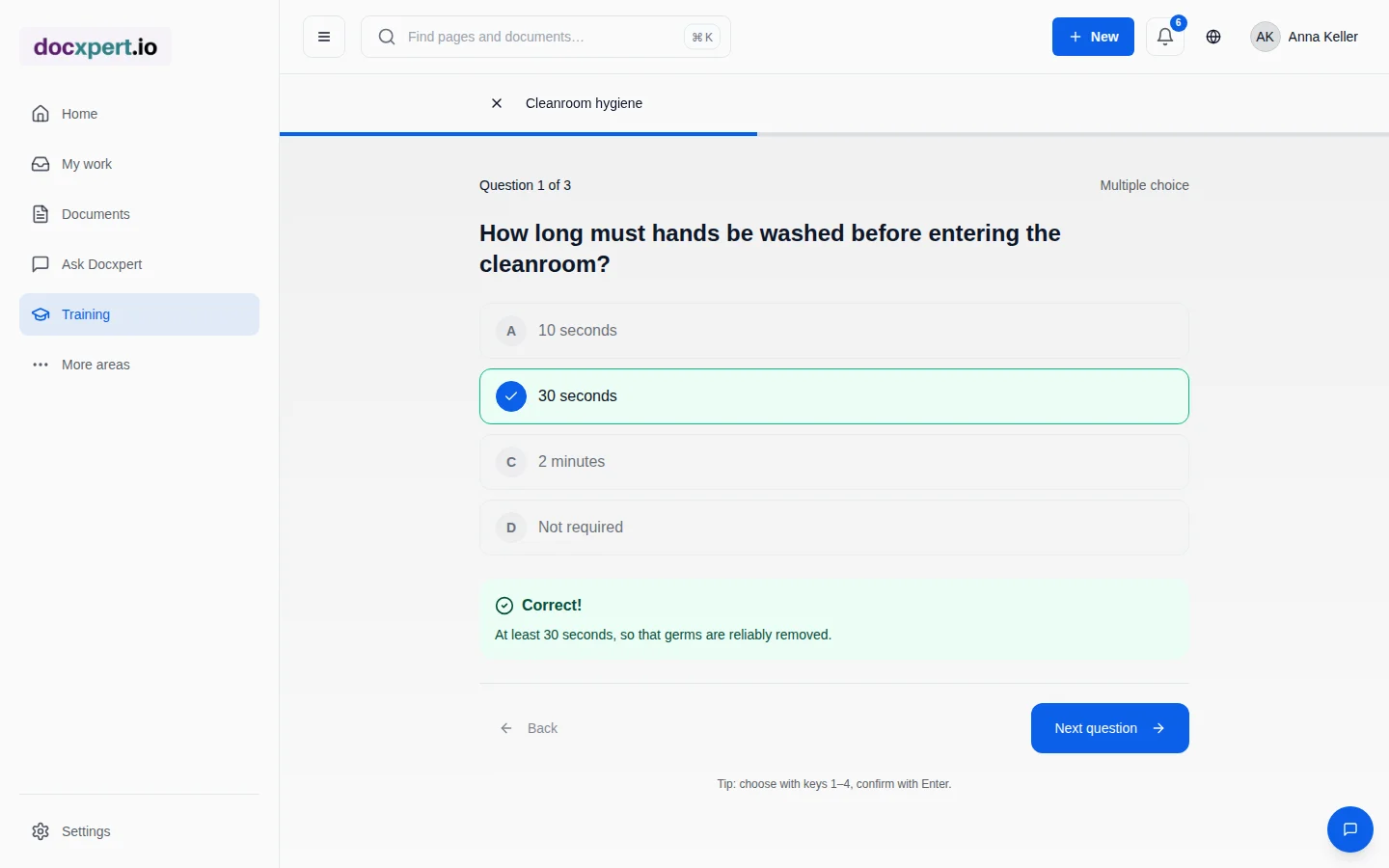
In docxpert you define for each training whether and after how many days an effectiveness review is due. On that date the reviewer gets a task in the inbox and rates each participant as "effective", "partially effective" or "not effective" – with a rationale. If "not effective", the training can be reassigned immediately. Quiz results from the learning check are also stored as evidence.
Frequently asked questions
How do I evaluate effectiveness for external seminars?
The same way as for internal trainings: set an objective, have the manager evaluate application after attendance and document the result. The provider's certificate of attendance only proves presence, not effectiveness in your own organisation.
How much effort is appropriate?
As much as the risk of the task justifies. For most trainings a learning check and a short manager evaluation are enough. Reserve elaborate KPI analyses for trainings with major impact.
Is a quiz enough to show effectiveness?
For low-risk trainings, often yes. For higher-risk tasks you should also check whether what was learned is applied at work – for example through observation or a manager's evaluation.
Does every briefing need an effectiveness check?
The standard requires evaluating the effectiveness of actions to acquire competence. You decide on a risk basis how deep the evaluation goes. For simple information a read acknowledgement with a short test can be enough.
Who should evaluate effectiveness?
Usually the direct manager, because they know the person's work. For technically demanding topics an expert can also evaluate.
When is the best time to evaluate?
Learning checks right after the training, behaviour evaluations after four to twelve weeks. Set the timing during planning.
What do I do if a training was not effective?
Clarify the cause, define a follow-up – such as retraining or revising the requirement – and evaluate again. Document everything.
Does effectiveness belong in the management review?
Yes. Results of effectiveness evaluations are a good indicator of training quality and are part of the inputs for resource and competence planning.
How can I tell whether training still works months later?
Choose an observable learning objective and a suitable follow-up date when planning the training. For a routine task, a manager can observe work after several weeks using the same criteria that were defined before training. For infrequent or high-risk work, add a supervised demonstration, a sample of work outputs or a realistic scenario. Do not ask only whether someone remembers the content; check whether the safe or correct action succeeds in the real process. Record the assessment, observer, date and conditions; differences between people or shifts may signal a process issue. If the expected result is missing, consider whether the training, work instruction or available equipment needs adjustment. This turns evaluation into a decision aid rather than a generic satisfaction survey.