
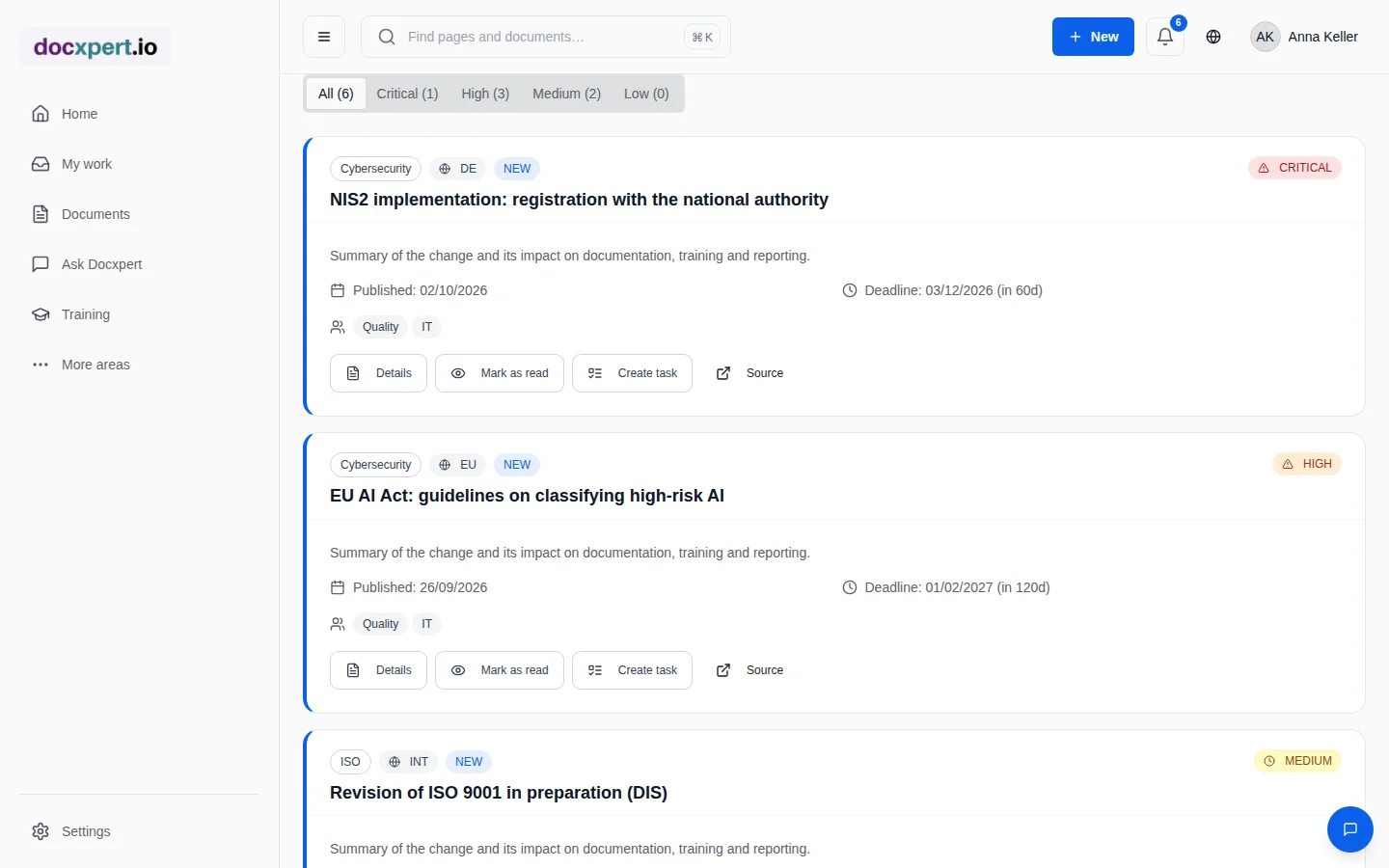
Why monitoring regulatory change is mandatory
New laws, regulations and editions of standards appear all the time – from NIS2 and the EU AI Act to changes in the Medical Device Regulation and chemical safety rules. Missing them risks fines, product bans and audit findings. At the same time, hardly any mid-sized company has a legal team that reads official journals every day.
Management system standards require you to know and monitor the relevant requirements of interested parties. ISO 14001 and ISO 45001 explicitly require you to determine and have access to compliance obligations and to evaluate compliance. ISO 9001 clause 4.2 requires relevant requirements to be monitored and reviewed. The regulatory radar provides the systematic basis for this.
How the radar works
- 1
Choose legal areas and countries
You subscribe to the areas that matter to you – quality management, medical devices, data protection, labour law, environment, product safety or cybersecurity – and to the countries you operate in.
- 2
Automatic analysis
At a chosen frequency – for example daily or weekly – the sources are checked. New entries are summarised and rated by impact: critical, high, medium or low.
- 3
Human review
AI analyses are marked as suggestions. A responsible person confirms or rejects the assessment before it counts as reviewed.
- 4
Assess and act
You mark changes as read or relevant, add notes and create a task with deadline and owner in one click.
Features at a glance
Covered countries and legal areas
| Region | Example sources |
|---|---|
| Germany | Federal Law Gazette, BSI, BfArM, BfDI, DIN, DAkkS, federal ministries |
| European Union | EUR-Lex (Official Journal), EDPB, EMA, Safety Gate |
| Austria and Switzerland | RIS, data protection authority, Fedlex, Swissmedic |
| Other countries | United Kingdom (legislation.gov.uk, ICO, MHRA), USA (FDA, OSHA), France, Italy, Spain, Croatia and more |
Legal areas range from quality management and ISO standards to medical devices, data protection, labour and tax law, environment, customs, product safety and cybersecurity.
Standards reference
| Standard | Requirement | Contribution of the radar |
|---|---|---|
| ISO 9001:2015, 4.2 | Monitor and review relevant requirements of interested parties | Ongoing monitoring with assessment |
| ISO 14001:2015, 6.1.3 and 9.1.2 | Determine compliance obligations, evaluate compliance | Basis for a legal register with change tracking |
| ISO 45001:2018, 6.1.3 | Determine legal and other requirements and keep them current | Spot changes in health and safety law |
| ISO 13485:2016, 4.1 and 5.2 | Take regulatory requirements into account | Medical device sources such as BfArM, EMA, Swissmedic, FDA, MHRA |
For environmental and health and safety management, the radar complements your legal register; see the pages on ISO 14001 and ISO 45001.
From finding to implementation: a lean process
Even the best radar is of little use if alerts sit unread. So define who assesses which legal areas and how quickly. A proven flow for mid-sized companies:
- Weekly review: one responsible person per legal area reviews new entries and confirms or rejects the AI assessment.
- Justify relevance: relevant changes get a short note on why and for which processes they apply.
- Derive actions: every relevant change results in at least one task – adapt a document, plan training or reassess a risk.
- Evaluate compliance: once a year, check whether all implemented changes are effective; the result feeds into the management review.
This flow produces, almost as a side effect, the evidence auditors expect for clauses 4.2, 6.1.3 and 9.1.2: you know your obligations, track changes and act demonstrably.
Example: implementing NIS2 on time
A manufacturer of control technology subscribes to cybersecurity and product safety for Germany and the EU. The radar reports the national NIS2 implementation with a registration duty and rates it as critical. The information security officer reviews the assessment, marks the change as relevant and creates tasks: check scope, prepare registration, define the reporting process.
The tasks appear in the owners' personal inboxes, implementation is steered with the NIS2 checklist, and incident reporting will run through NIS2 incident reporting in docxpert.
Frequently asked questions
Which companies benefit most from the radar?
Companies in regulated industries such as medical devices, pharmaceuticals, automotive or energy, and anyone operating in several countries or running environmental and health and safety management under ISO 14001 or ISO 45001.
Can I change countries and legal areas later?
Yes, at any time. Changes apply from the next run; entries and assessments already recorded are kept.
Which sources does the regulatory radar use?
More than 60 official sources such as official journals, authorities and standards bodies. Only sources from a vetted list are queried.
How often are changes checked?
You choose the frequency, for example daily or weekly. The scope follows from countries and legal areas.
Does the radar replace a legal register?
It is the basis for an up-to-date legal register because it detects changes and documents assessments. You still maintain the list of your compliance obligations as a controlled document.
How reliable are the AI assessments?
They are marked as suggestions and must be confirmed by a responsible person. That keeps the assessment traceable and under human responsibility.
Can I turn a change into a task directly?
Yes. One click creates a task with owner and deadline that appears in the personal inbox.